 55% Off Preaching Bibles
 Finally Home
We Must Commit to the Functional Centrality of the Gospel

The Greatest and Most Crying Need of the Church Today
Several years ago, I received an invitation to participate in a gathering of pastors from around the United States. Prior to that gathering, we participants were asked to submit answers to this question: What is the greatest and most crying need in the church today? This is what I wrote:
What is the greatest and most crying need in the church today? Not just a biblical/theological literacy but a functioning theological/biblical literacy, especially a functioning gospel. I believe a local church is healthy to the degree that: (1) its pastor- teachers are able—accurately, effectively, broadly—to bring the gospel to bear specifically into the real lives of the people; and (2) its people have a deep personal understanding of and a deep personal appreciation for the gospel so as to be able to live in the good of the gospel daily. One of the greatest challenges, yet one of the most important tasks, of pastoral ministry is to help people actually see the connections between the gospel and the thinking and behavior that make up their everyday lives. We know well the centrality of the gospel message but in order for it to have a functional centrality it must be clearly, carefully, and consistently connected to the real issues—issues of thought and conduct—of people’s lives. This kind of ministry is most greatly needed.
Let’s be clear: We all know what the greatest and most crying need of the church is. It’s Jesus. He is the bread of life. He is the light of the world. He is the way, the truth, and the life. He is the head of the church. And the gospel is simply the good news about Jesus.
Therefore, we must be careful not to drive a wedge between Jesus and the language of “the gospel.” It is simply the Bible’s way of speaking of the person and work of Jesus, and that is what we all desperately need to function in our lives and in our churches.
We need the word of the gospel, the truth of the gospel, and the good news of the gospel. And we need the gospel to function in the local church—my local church and yours. I know this not as the result of a mental exercise of reflection but because of a personally and regularly observed need both in my life and in the lives of others. We need the gospel to do its work.
It’s not as if we are asking the gospel to do something it can’t do. The gospel does tremendous work. In Romans 1:16 Paul says, “I am not ashamed of the gospel, for it is the power of God for salvation to everyone who believes.” After it has done its work of regeneration, it continues to be the instrument of all our spiritual growth. Here’s how Paul describes this work in Colossians 1:5–6: “The gospel, which has come to you, as indeed in the whole world it is bearing fruit and increasing—as it also does among you, since the day you heard it and understood the grace of God in truth.” Notice that sequence. The Colossians first heard and understood the gospel, and after that it continued to grow and bear fruit among them—that is, among those who had already heard and believed.
So we must consider the ongoing functioning of the gospel in the life of the Christian and the local church. To do so, we must start by setting forth a biblical paradigm for the functional centrality of the gospel. It’s important to stress that this is a biblical paradigm. We understand the importance of the gospel as a biblical idea. I’m eager to demonstrate that the functioning of the gospel isn’t just something that was brain-spun by men; rather, it’s a thoroughly biblical idea.

The Heart of Preaching
Mike Bullmore
Mike Bullmore’s The Heart of Preaching explores the functional centrality of the gospel in the life of a preacher, helping pastors shape their character, content, and mindset toward a gospel-centered life.
The Centrality of the Gospel
Consider three concentric circles. In the center circle is the gospel itself.
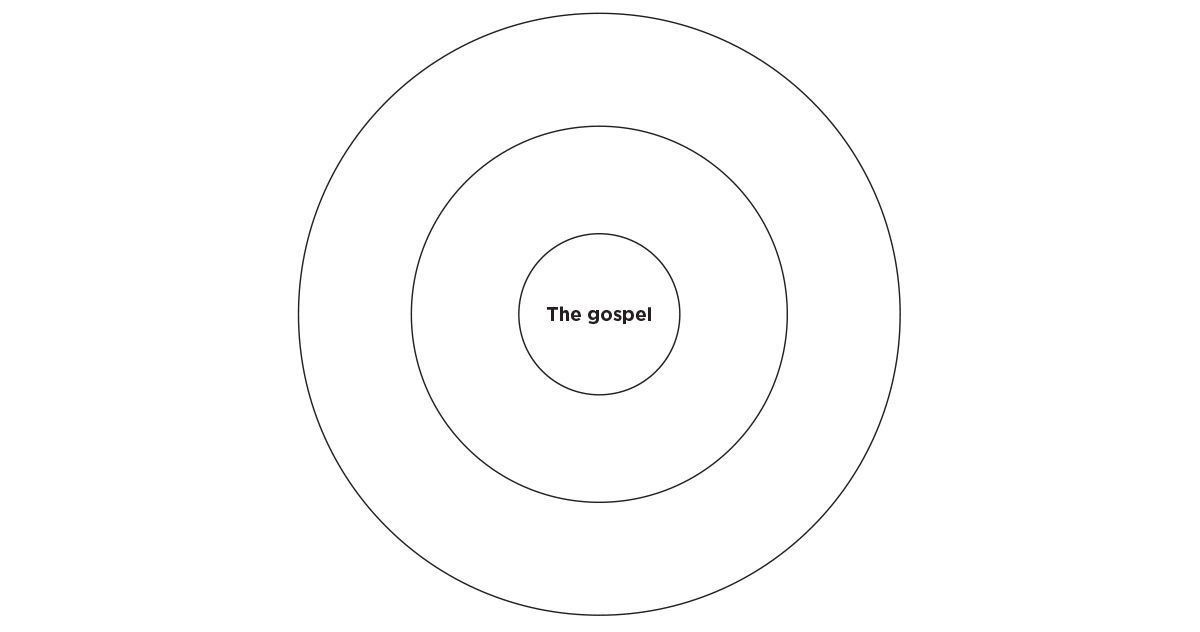
We can think of this diagram as an illustration of the essential, or theological, centrality of the gospel. We see this in several explicit statements in Scripture, perhaps most notably in 1 Corinthians 15:1–4, where Paul gives a wonderfully succinct summary. While we must be careful not to reduce the gospel to Christ’s substitutionary atonement—the entirety of the person and work of Christ must be included—certainly we can say that the heart of the gospel is contained in these five remarkable words: “Christ died for our sins” (1 Cor. 15:3). That statement contains the essential truth at the heart of the gospel. It speaks of the reality of our sin, the necessity of divine judgment, and the wonderful provision of salvation from God’s judgment through the death of his own Son in our place.
But the point to pick up from 1 Corinthians 15:3 is that Paul speaks of this gospel as a matter of “first importance.” In other words, there’s a theological priority to this message. Paul himself gave it priority in his preaching and teaching. He writes to the Corinthians, “I decided to know nothing among you except Jesus Christ and him crucified” (1 Cor. 2:2). He says to the Galatians, “Far be it from me to boast except in the cross of our Lord Jesus Christ” (Gal. 6:14).
We see the theological centrality of the gospel in the very storyline of Scripture. The Bible is the story of God’s saving grace through Jesus Christ; everything in Scripture before the cross points ahead to God’s redemptive work in Christ, and everything after the cross flows from that work.
The gospel is the innermost circle because it is Christianity’s essential theological center.
But in order for that gospel to have a functional centrality for the church, we must make connections between the gospel and our lives—to areas, patterns, and even deep structures of our thought and conduct. It needs to be connected to and applied to every area of our thinking, feeling, relating, and behaving. It’s these connections that make the gospel function. The gospel wields its influence and “bears fruit” through them. These connections prevent the gospel from being a theological abstraction.
This brings us to the second and third circles in our diagram.
Doctrinal Implications of the Gospel—Gospel Truths
The second circle introduces the doctrinal implications of the gospel—what we might call gospel truths. Notice the plural. I am not referring to the gospel truth itself. Rather, I have in mind things that are true because of the gospel. They are implications of the gospel. They grow out of the gospel.
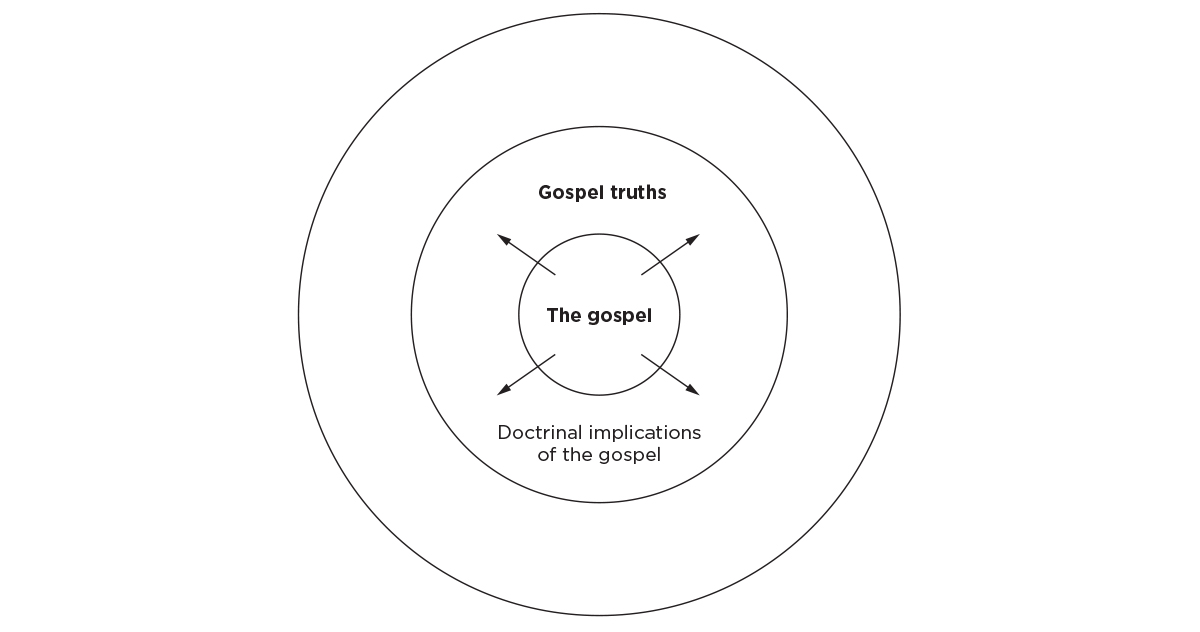
Paul recognizes this category when he speaks about doctrine that is “in accordance with the gospel” (1 Tim. 1:11). This is doctrine with a shape and substance determined by the gospel. This doctrine isn’t just true—it is what it is precisely because the gospel is what it is. And these doctrinal implications of the gospel, these gospel truths, bring the gospel to bear and cause it to function in our lives, especially in our minds. Gospel truths are useful for renewing our minds so that our thinking—its content, patterns, and structures—is more and more shaped by the truth of the gospel.
Think about how much of your life takes place in your mind—your hopes, fears, desires, and plans. God intends all of that to be shaped by the gospel. It’s exactly this that Paul is speaking of in Romans 15:13 when he says, “May the God of hope fill you with all joy and peace in believing, so that by the power of the Holy Spirit you may abound in hope.” In other words, by believing certain things—gospel truths—the gospel functions and bears the fruit of real joy, peace, and hope.
Consider Romans 8:1: “There is therefore now no condemnation for those who are in Christ Jesus.” Again, notice the logic carried in the word therefore. Once again, Paul is standing with both feet firmly planted in the gospel and speaking a gospel truth, something that is true specifically because of the gospel.
This gospel truth is absolutely stunning. There is now no condemnation! When believers fully comprehend that truth, it revolutionizes their mental world; the gospel becomes functional for them. Without the gospel, in the face of our ongoing sin, we are tempted to self-achievement or despair. But what a difference it makes when the radical grace of God in the gospel is the functioning standard of our thinking with reference to how God now views our sin. How liberating this is for Christians who are used to living in condemnation. It’s not that God doesn’t deal with our sin. It’s just that he no longer deals with our sin according to our sin (Ps. 103:10). He now deals with us and our sin according to his steadfast love for us in Christ.
The dynamic here is like the operation of an enormous flywheel—a massive, weighty disc designed to spin rapidly and transfer its power and momentum to something else. It’s so huge that it takes a while to get it going. But once it is turning, it has the power to get things done as we attach other things to it. The gospel is like that. If the gospel is central in your life and ministry, providing power and momentum, then these connections enable you to apply the gospel to people’s thinking, believing, and hoping. In other words, the gospel finally becomes functional.
The gospel is the innermost circle because it is Christianity’s essential theological center.
Behavioral Implications of the Gospel—Gospel Conduct
Beyond the shaping of our thinking by the doctrinal implications of the gospel, there is another level of connections—our third circle—that link the gospel to our behavior, leading to what we could call gospel conduct.
Paul tells the Philippian believers to “let your manner of life be worthy of the gospel” (Phil. 1:27). He’s speaking of gospel conduct. There’s also that moment in Galatians 2:14 when Paul tells of confronting Peter and his friends because their “conduct was not in step with the truth of the gospel.” Clearly our conduct must grow out of and accord with the specific content of the gospel. In other words, one of the ways the gospel functions is by specifically informing our behavior.
I want to emphasize that word specifically. As Christians, and especially as ministers of the gospel, we need to be reading the Bible with an eye to detecting the specific connections it makes between the gospel and particular behaviors.
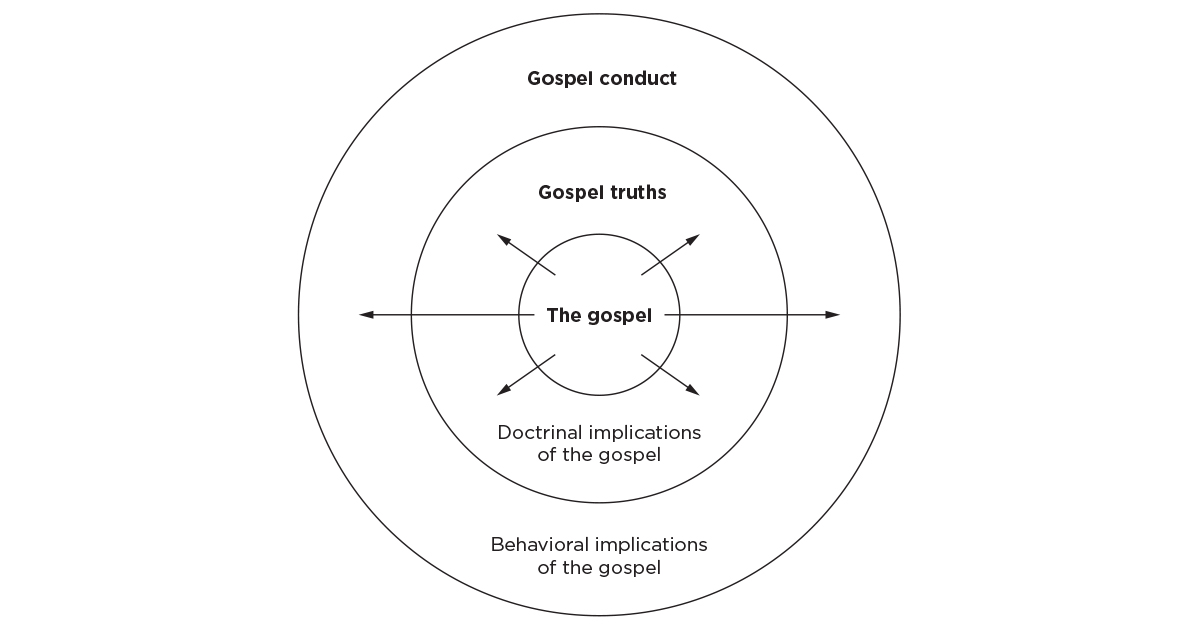
For example, when Paul appeals to the Corinthians to “flee from sexual immorality” (1 Cor. 6:18), he makes an explicit and very specific connection to the gospel. He wants the gospel to function as it should. He doesn’t just engage in moralism, telling them to behave themselves in the area of sexuality. He reminds them of the gospel: “For you were bought with a price. So glorify God in your body” (1 Cor. 6:20). Paul attaches this behavioral exhortation to the already moving flywheel of the gospel, and by so doing he gives gospel momentum to sexual purity as opposed to giving a moral exhortation and leaving it to float on its own. We know what happens to a flimsy moral exhortation if it’s left on its own. It has no staying power. But if it is firmly connected to the gospel, then the gospel will function to carry something forward that is very glorifying to God.
We see the same kind of thing in Ephesians 4:32. Paul says, “Be kind to one another, tenderhearted, forgiving one another, as God in Christ forgave you.” It is clear that both the model and the motivation for our conduct of forgiveness are what we experienced in the gospel. When we make that connection, the gospel functions to bring about a distinctive Christian conduct.
Think of Paul’s instructions to husbands in Ephesians 5:25 regarding their conduct toward their wives: “Husbands, love your wives, as Christ loved the church and gave himself up for her.” At the end of that verse we have a wonderful restatement of the heart of the gospel and how it gives power and momentum to our behavior as husbands.
Many, many more examples could be given. The gospel has things to say about racism, suffering, self-control, our worship, and caring for the poor. Ultimately, all Christian behavior should flow out of the gospel. By seeing and helping others see the specific lines of connection between the gospel and patterns of behavior, we allow the gospel to function and bear unique, God-honoring fruit. Seeing those connections taps into the momentum and power of the big gospel flywheel, and helping believers see them is a significant part of our job as ministers of the gospel. We must make these connections clearly, carefully, and consistently. When we do, we are not just leveraging the logic of the gospel of Jesus Christ. We are harnessing its life-giving power.
That is the paradigm for the functional centrality of the gospel. I’ve tried to demonstrate that it is a biblical paradigm. I’ve tried to show not just that there are truths and exhortations but also that they take their cue directly and explicitly from the gospel. They are truly gospel truths, meant to shape our thinking. They are truly exhortations to gospel conduct, meant to shape our behavior.
This article is adapted from The Heart of Preaching: The Functional Centrality of the Gospel in the Life and Work of the Preacher by Mike Bullmore.

Related Articles

5 Ways Pastors Can Grow in Their Preaching
No one can create an effective Bible preacher. No process of training can ensure the quality of the end product because preaching involves many different aspects of mind and personality.

Why You Need Confidence to Teach the Bible
Anyone who is going to teach the Bible needs real conviction that God acts through the proclamation of his word. Additionally, you need confidence in the Holy Spirit.

Dear Pastor, You Must Prioritize Godliness over Giftedness
I see three lines of argument emerging from Scripture that together make a compelling case for the priority of godliness in the life of the pastor/preacher.

Podcast: The Path Preachers Should Take and the Ditches on Either Side (Mike Bullmore)
Mike Bullmore shares encouragement and advice for preachers today.


